


A-24328: a code that Estelle Golden grew up seeing tattooed on her mother’s arm, but never understood the real significance of. When she was finally told the story as a teenager, it was as if the pieces of a complex puzzle had finally fallen into place; her accent, her distinct mannerisms, the tattoo, all began to make sense.
On Thursday, May 21, more than 130 freshman students from the Sequoia and Stumptown academies gathered in the Cleveland library to listen to Estelle Golden share her mother Diana Galante’s story, a Holocaust survivor. Over the last nine years, Matthew Sten, a Cleveland Modern World History teacher, has invited speakers to come and provide testimony of their experiences during the freshman Holocaust unit. Estelle Golden has been a part of this opportunity for three consecutive years.
When asked why this presentation, only a little longer than an hour, was important to his student’s understanding of the Holocaust, Sten shared that “it’s incomparable. We can read books and watch movies, even listen to testimony from actual survivors through a website, but to be in the same room with someone whose mother survived, and can look us in the eyes and say ‘if my mother hadn’t survived I wouldn’t be here with you,’ there isn’t anything like it.”
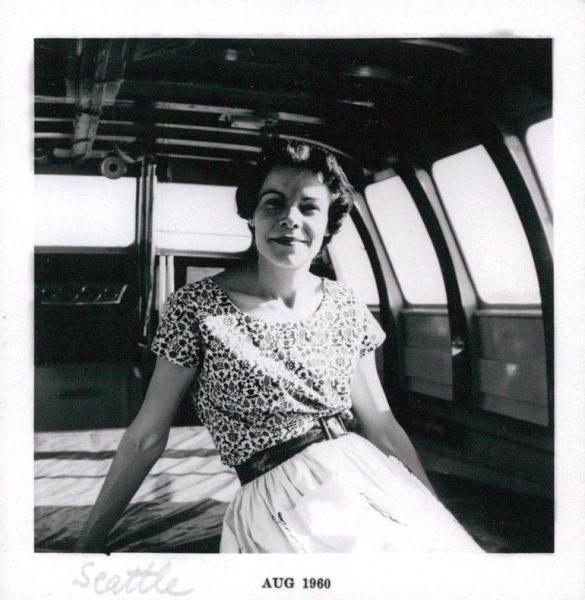
Diana Galante was born in Rhodes, Italy in 1922, which at the time had a thriving Jewish community of almost 2,000 individuals. “Her early life was rich with family, faith, and community,” Golden said. Simultaneously, Italy began to align with Hitler’s Nazi occupied Germany, and anti-semitic laws were consequently passed by Rhode’s new fascist leader. At 21 years old, Diana left Rhodes for the first time, expelled from her home by Nazi soldiers. In a letter written to relatives on September 9, 1945, she wrote in a letter that “after a terrible voyage lasting eight days, we are transported to Haidari, a concentration camp three kilometers from the port.” Here, she was separated from her parents and arrived at the most infamous concentration camp: Auschwitz.
“As soon as we got off the cars, the four officers of the SS who seemed bloody executioners stood in front of us. They made the selection in this way: age, mothers, skinny versus weak, and the same fate was also for the men,” said Diana in the letter. She was forced to strip naked, tattooed, shaved, disinfected, and sent to the cold showers. In these showers, an asphyxiating gas would sometimes be administered in place of water to kill prisoners, whose bodies were then passed down through trap doors in the floor and cremated.
Diana was assigned to Barracks 20 alongside her sisters. Day after day, she abruptly woke at four a.m. to the sounds of whistles, lining up and waiting for officers to decide whether she and the other prisoners were suitable to continue to work. “For breakfast, prisoners were served what was called ‘coffee,’ but really it was just brown water,” Estelle told the students.
“What they did was guide us about a couple of miles away to a mound of bricks. In the morning, those bricks are cold like an ice tray, and we would have to pick two bricks and walk, taking them back and forth. It was more of a punishment. SS women had dogs, and if a girl fell down or fainted, they would send a German Shepherd after her to dismember her,” Diana said in a video. Estelle frequently provided direct footage of Diana recounting her life during the Holocaust. During these videos, it was silent; there was an almost tangible air of fixation from the students watching.
“My three cousins, the other girls, all three died within a week from each other. At the end of the day, male prisoners would come with the push carts, and one man would take the dead girls by the shoulders and the others by the legs and ‘bang, bang’… we used to look up to the sky and ask ‘God, why?’” Diana said in one of the videos.
The Russian army was advancing towards Auschwitz, and in response, the Nazis began to swiftly kill mass amounts of prisoners. Around the third week, Diana passed an inspection and was allowed to travel to Germany, though she had to leave behind her sister Felicia. “She said she felt lucky to go by train, because so many others were sent on a long, forced march,” Estelle said.
Diana did not remember where she arrived, but she recalls brand new barracks and an ammunition factory where she began to work. Later, she found out it was Saxony. “Beaten always with sticks, 11 hours of work every day, five days a week. And the hunger was terrible, because we received eighty grams of bread and one liter of hot water a day,” she said.
“On the 24th or 26th of April, they put us in open box cars, and took us several places, but we got nowhere until we arrived in Terresinstadt. Upon arriving, the SS took the uniforms off and put on civilian clothes and disappeared. They were all gone.” On May 9, 1945, Russian soldiers told the Jewish prisoners “you are free now, you are free.”
In 1949, sponsored by relatives, Diana immigrated to America, where she met her husband, who was a Portland musician. She had two daughters, including Estelle Golden.
Estelle’s final words consisted of an incredibly powerful quote from her mother, something she expressed was the sentiment she most hoped students took away from Diana’s story. “I try not to be bitter or angry or ask for revenge. What would that solve? You cannot conquer hate with more hate, only with love. All I want to do is have my own life and not repeat the mistakes or horrors that the Nazis did. The choice is mine. I choose caring. I choose love.”
The presentation ended with questions answered by Estelle regarding women’s healthcare and work in the concentration camps, and how she approached the conversation with her mother about what she had experienced. “When she heard a man on the television in the 1970s lie about the Holocaust, my mom decided that she was gonna talk about it. Then when she got more speaking gigs, that’s when I got the first sense of it,” she said.
This reporter asked what Estelle’s favorite part of sharing her mom’s story with the students was, and she earnestly replied, “The questions. The curiosity is so genuine and they truly are deep thinkers … a lot more deep than you think.”
While she did not have the opportunity to cover it in this specific presentation, Estelle often also speaks to the importance of being critical of modern media and news sources in addition to her mother’s story. “I do worry that people are fed lies, and that’s what happened in Europe in 1930. That’s how Jews could be removed from the population in front of everyone, and they just watched them disappear. It wasn’t done silently, it was all done right in the open. That could happen again tomorrow. To anybody. About anything. And because so many people are not exposed to good journalism, I worry that we’re all sort of sitting ducks,” she said.
Estelle’s presentation provides students with a new lens through which they can view history: events in time that affected real people and real families. “Personal stories make you feel more connected to the victims of the Holocaust. And hearing small little details and people’s names make you feel more empathetic to their experiences,” said freshman Sylvia Willey and Ruby Galm, both part of the Sequoia academy.
Having the opportunity to listen to a woman authentically speak of her mother’s time as a target of genocide is, for all students who watch Golden share her mother’s words, is a transformational experience in terms of how they perceive what they learn in the classroom.