


A heightened amount of Immigrations and Customs Enforcement (ICE) activity in Portland has severely affected local communities and schools, raising alarm and causing distress.
After receiving word of nearby ICE activity in North Portland, César Chávez School and George Middle School went into Secure the Perimeter Protocol on Nov. 6. All exterior doors had to be locked, but classes continued as usual. Other nearby schools such as Roosevelt High School also increased security measures during this time.
This protocol in response to ICE has been put into place by PPS as a safeguard to prevent ICE from illegally entering schools and targeting students. ICE agents are not permitted past the front desk without a judicial warrant. Schools must initiate a lockdown if ICE tries to proceed without the valid documentation required.
According to the American Immigration Council, under the Trump Administration, ICE’s estimated budget for the 2025 year alone is approximately $28 billion dollars, which is a dramatic increase from previous years.
However, students are refusing to stand down. The Cleveland Alliance for Racial Equity (CARE) has decided to raise awareness and money in support of immigrants.
At the Fall Community Showcase assembly on Nov. 12, representatives from CARE gave a presentation on safety precautions one can take against ICE, and ways to aid those affected.
“A huge thanks to everybody in the audience for the engagement. We literally had to like, pause after every slide for applause. It was the best feeling ever,” said Lizzie Corrigan, a representative from CARE.
Corrigan and Sable Jackson, CARE’s ICE Awareness team, presented a fundraiser aimed to help mitigate the ICE issue.
“It’s the Schnitzer CARE program, and they give out grants to certain non-profits. And like, our main focus right now is raising money to support immigrants and immigrant families who have been detained by ICE,” said Jackson.
The hope is that these funds can be utilized for legal resources for those detained. While important, money isn’t the only way to contribute to the cause.
“Most importantly to us, we’ve been spreading awareness because you can’t do anything if you don’t know anything. We’re creating a community so people who are worried about ICE can feel like Cleveland is a safe space and we’re not going to let anything happen to them,” Jackson said.
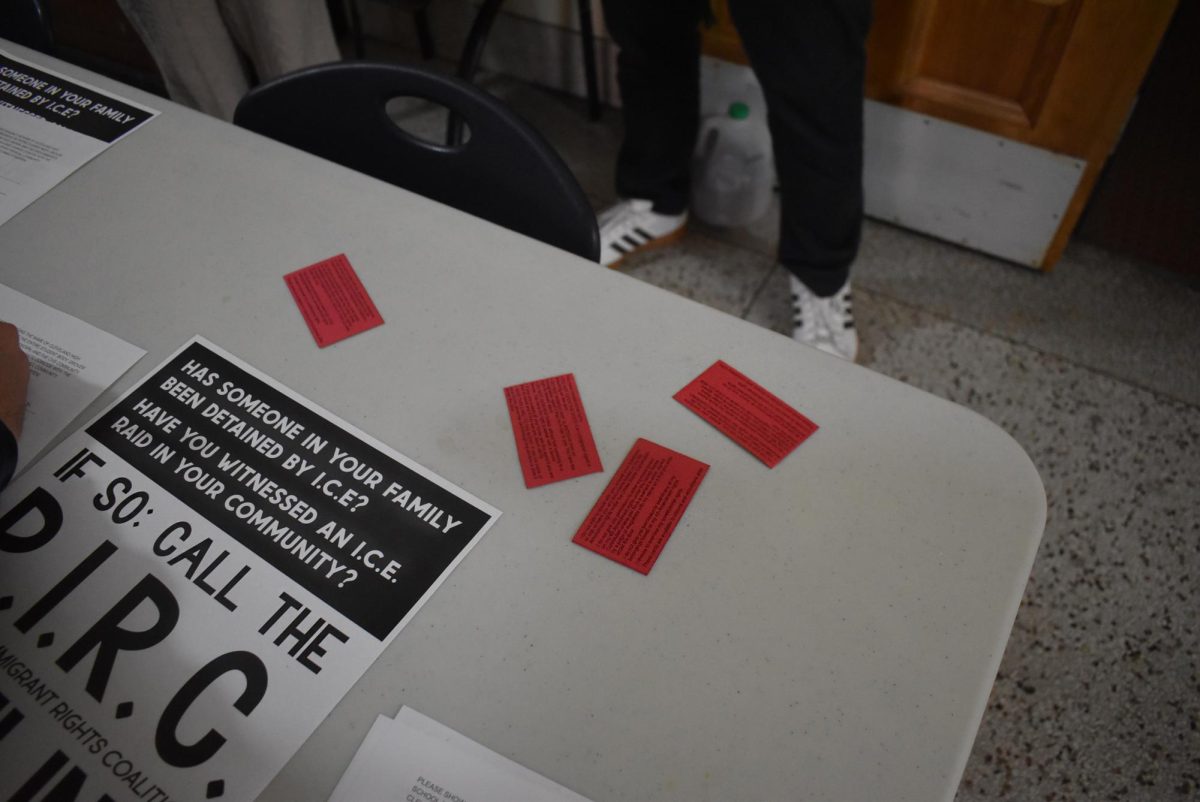
“We’ve also been printing out red cards that we’re going to put around the school soon for people to be able to take, which is a very important resource. And soon, hopefully we might have a newsletter happening with like, ICE specific local news,” said Corrigan.
She noted that it can often be a struggle to find reliable sources online, and hopes to spread credible and current information so students are aware of their rights.
“The cool thing is people do care, even in, like, a predominantly white school like Cleveland where you’d expect a lot of people to kind of have the attitude that it’s like not my problem, it’s cool that we were able to have support from the whole student body,” Jackson said.
Corrigan and Jackson explained that the first step to fighting back against ICE is for people to simply raise awareness and educate themselves, even if they are not directly affected.
“The more privilege you have, and the more that you can use that privilege to help other people,” Corrigan said.